
For Croatian institutions
Fiscalization, eRačun and all the paperwork of an učilište, in one system
Amber is developed in Split and keeps up with Croatian rules as they change. Since 1 January 2026 every invoice to a private person has to be fiscalized the moment it is issued, bank transfers included, and companies receive eRačuni. Here’s how Amber handles it for you.
Fiscalization (F1)
Every invoice, every payment method
Invoices from fiscal locations are fiscalized as soon as they are issued, whether paid in cash, by card or by bank transfer. The JIR, ZKI and number are printed on the invoice.
At the desk
The cash register fiscalizes straight away and shows the number and JIR. Tax Administration unreachable? Fiscalize again sends the invoice later.
Nothing slips through
A "JIR missing" filter and a red Fiscalize all bar on the dashboard catch anything left over, and you can’t close the register until everything is fiscalized.
Fiscalized means final
Once fiscalized, an invoice can’t be edited or deleted, and its number is never reused. Corrections go through linked cancellation invoices.
eRačun (F2)
Created automatically
If a customer receives e-invoices, every invoice Amber generates for them becomes an eRačun (UBL 2.1). You can add buyer references such as an order or contract number.
Sent through ePoslovanje
Send now opens the e-invoice screen and sends them through ePoslovanje. You can also download the XML.
KPD and tax categories
Billable services carry KPD codes, and VAT rates and exemptions carry tax categories, just as e-invoices require.
Incoming e-invoices
Read a supplier’s e-invoice XML straight into Amber. It picks up the number, date, total, your company and the supplier by OIB, plus the embedded PDF.
What stays in your ePoslovanje account
We’d rather be precise about this. Today you receive eRačuni, and report payments for the eRačuni you issued (eIzvještavanje, due by the 20th of the following month), in your own ePoslovanje account. Amber reads the e-invoices you receive and keeps your invoices and payments in order, so the reporting is quick work.
From 1 January 2027 institutions that are not VAT payers must issue eRačuni too. Amber is ready for that already: it creates eRačuni for every customer marked as an e-invoice recipient.
Banks and payments
HUB3 statements
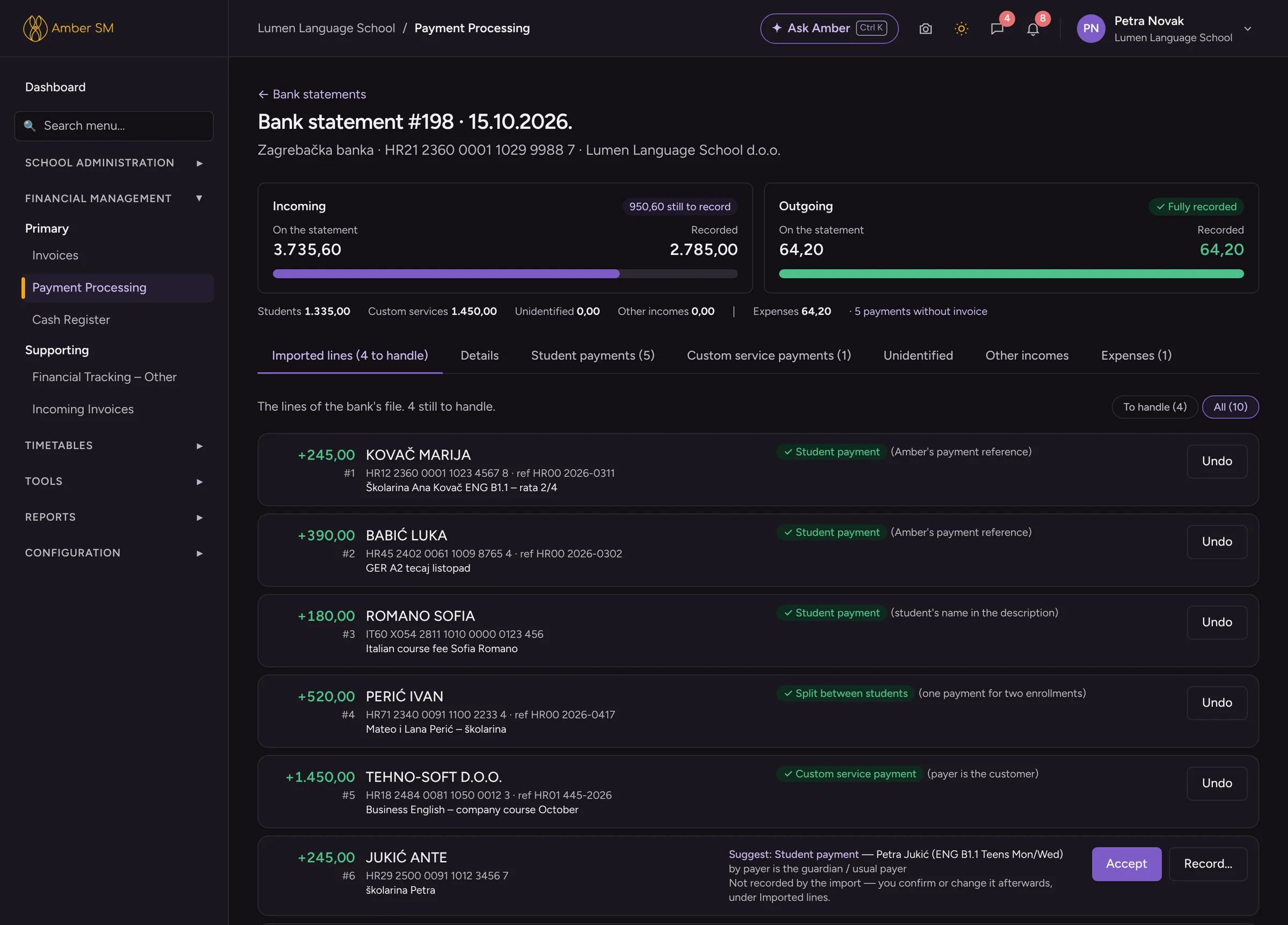
Import statements from Croatian banks, and Amber matches payments by poziv na broj with a check digit.
HUB-3A payment slips
Print a barcoded slip for every instalment of a payment plan.
Cash limit and closing
Zaključak blagajne, bank deposits, and a reminder whenever the cash on hand goes over your blagajnički maksimum.
Adult education (učilišta)
Matični brojevi and matična knjiga
Keep log books with templates and number ranges. Amber assigns the next number for you and prints a log book page for each student.
Ministry verifications
Store each rješenje (klasa, ur. broj, date) per programme, level and location, and Amber picks the right one on every certificate.
AZUP, KLASA/URBROJ, HKO
Export a group to AZUP as XML, number documents on two tiers, and record learning outcomes with CSVET credits and HKO level.
Questions schools ask
Do schools in Croatia have to fiscalize bank-transfer invoices?
Yes. Under the Fiscalization Act (NN 89/2025), since 1 January 2026 every invoice to a private person must be fiscalized when it is issued, however it is paid. The VAT exemption for education doesn’t change that.
Does a school that is not in the VAT system need eRačun?
Since 1 January 2026 every school must be able to receive eRačuni, and from 1 January 2027 schools that are not VAT payers must also issue them to businesses. Your accountant can confirm exactly what applies to you.
Which intermediary does Amber use for eRačun?
ePoslovanje. Your school authorises it in ePorezna and keeps its own account there.
Let’s check your school’s case
Feel free to bring your accountant to the demo. We’ll show you exactly how your invoices would go out.